
Long-Term Care Partnership Guide for 2026
Protect 100% of Your Life’s Savings with a Long-Term Care Partnership Policy
Discover how state-approved Long-Term Care Partnership Programs give you dollar-for-dollar asset protection against Medicaid spend-down—without overpaying for coverage

LTC Partnership
Most middle-class retirees don't need a million-dollar insurance policy
Independent long-term care insurance specialists with nationwide experience, educational resources, and step-by-step guidance.
Scott A. Olson, CLTC® has been licensed for 30+ years. NPN:617232
Direct Summary • Reviewed by Scott A. Olson, CLTC
What is the State Long-Term Care Partnership Program?
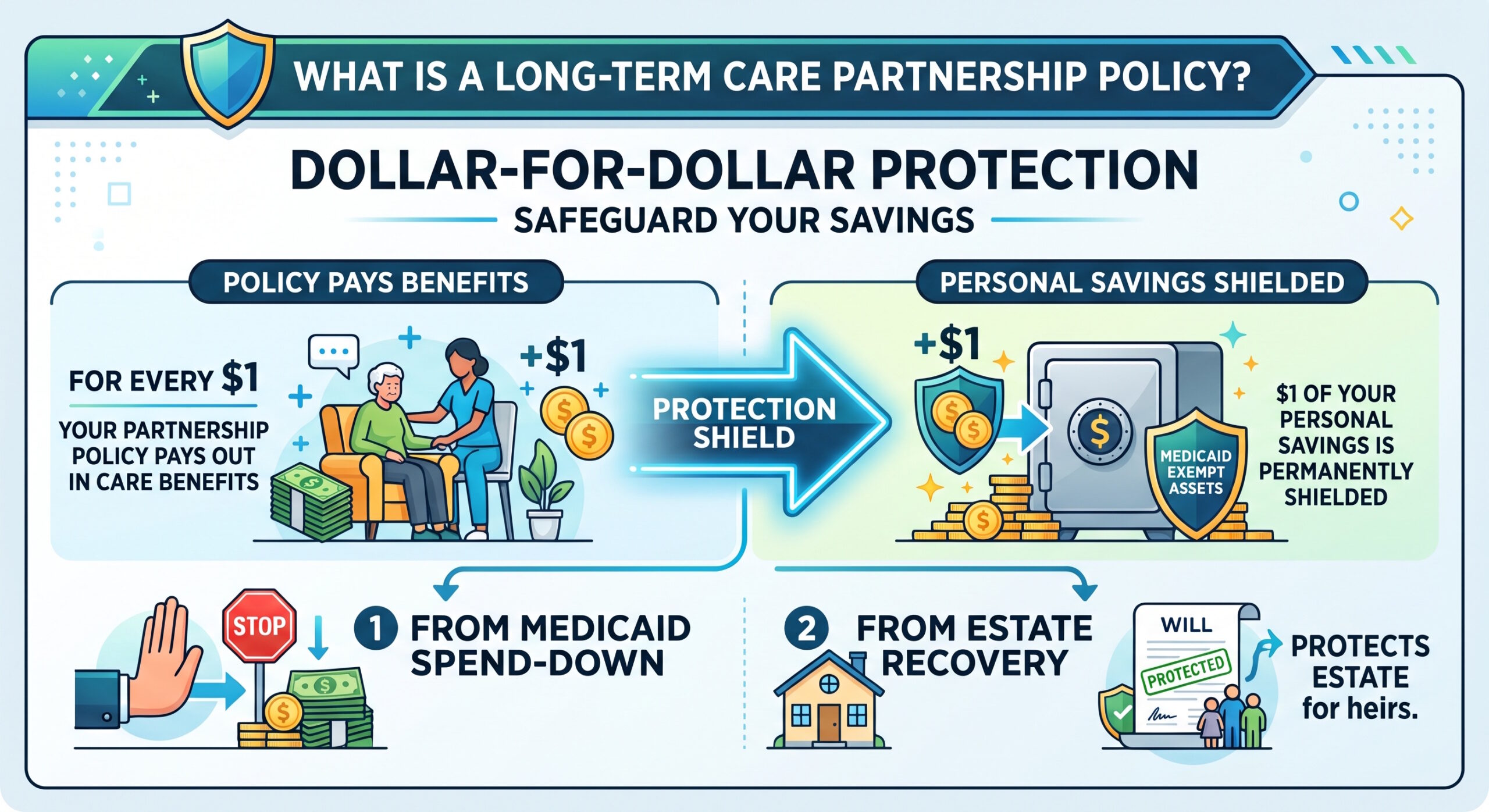
The Long-Term Care Partnership Program is a alliance between state Medicaid agencies and private insurance carriers. It provides dollar-for-dollar asset protection: for every dollar your Partnership policy pays in benefits, you can keep a dollar of personal assets while still qualifying for Medicaid, without spend-down or estate recovery penalties.
How Does Dollar-for-Dollar Medicaid Asset Disregard Work?
Standard Medicaid rules require individuals to exhaust almost all liquid assets (typically down to $2,000) before receiving benefits. Under a Partnership Policy, state Medicaid programs apply an "asset disregard." If your policy pays out $300,000 in qualifying benefits, Medicaid allows you to retain $300,000 in personal savings, stocks, or real estate above the standard asset limit when applying for assistance.
What Are the Required Inflation Protection Rules for Partnership Policies?
To qualify for Partnership status under federal guidelines (Deficit Reduction Act of 2005), policies must include specific inflation protection based on the applicant's age at purchase:
- Under Age 61: Must include automatic compound annual inflation protection.
- Ages 61 to 75: Must include some form of inflation protection (compound or simple).
- Age 76 and Older: Inflation protection is optional, though offered.
Does My Partnership Policy Move With Me to Another State?
Most participating states participate in the National Reciprocity Agreement. If you purchase a Partnership policy in one state and move to another participating state, your asset protection remains intact. However, Medicaid eligibility rules and benefit payments are administered according to the state where long-term care services are received.
Important Regulatory Notice: Partnership program availability, inflation requirements, and asset disregard guidelines vary by state. Consult with a licensed Long-Term Care specialist (CLTC) to verify specific state regulations. LTCShop.com provides non-binding educational information and independent carrier comparisons.
Interactive U.S. Long-Term Care Partnership Program Map
Select any state to explore state-specific Medicaid asset protection guidelines, partnership qualification rules, or return to our central hub.
Texas (TX)
Texas participates in the Long-Term Care Partnership Program. Policies offer dollar-for-dollar Medicaid asset protection to safeguard personal savings and home equity.
| Feature / Benefit | Long-Term Care Partnership Policy | Traditional LTC Insurance | Single-Premium Life/LTC Hybrid |
|---|---|---|---|
| Medicaid Asset Protection | Yes (Dollar-for-Dollar) | No | No |
| Cost Efficiency & Premium Ratio | Highest (Targeted Assets) | High | Low (2x to 4x More Expensive) |
| Mandatory Inflation Protection | Yes (State Required) | Optional | Often None or Limited |
| Tax-Qualified Status (IRC Section 7702B) | Yes (100% Tax-Qualified) | Yes (If federally qualified) | Varies (Only LTC rider portion) |
| Tax-Free Benefits | Yes (Reimbursement / Per Diem) | Yes | Yes (LTC payout portion only) |
| HSA & Self-Employed Deductions | Eligible up to IRS age limits | Eligible up to IRS age limits | Generally not eligible for full premium |
| Requires Specialized Agent CE Training | Yes (CE Certified Every 2 Years) | Yes | No |
In this video, certified specialist Carolyn Olson, CLTC®, explains the key differences between traditional long-term care insurance and Long-Term Care Partnership policies [
While traditional long-term care policies cover initial care, policyholders who exhaust their benefits must still spend down their remaining assets to qualify for Medicaid [
Frequently Asked Questions: Partnership LTC Insurance
Reviewed by Scott A. Olson, CLTC® | Updated for 2026 State Guidelines
How does a Long-Term Care Partnership Policy protect my assets from Medicaid spend-down?
A Long-Term Care Partnership Policy provides dollar-for-dollar asset protection (also known as "Asset Disregard"). For every dollar of benefits your policy pays out toward qualifying care, state Medicaid programs allow you to keep an equivalent dollar of your personal savings and assets above the standard eligibility threshold ($2,000 in most states).
Real-World Example: If your Partnership policy pays out $350,000 in home care or nursing home benefits and you eventually need Medicaid, you can retain $350,000 in private assets (stocks, real estate, cash) without being forced to "spend down" to qualify. Furthermore, these protected assets are legally exempt from State Estate Recovery after death.
What inflation protection is required for a policy to qualify for Partnership status?
Federal law under the Deficit Reduction Act (DRA) of 2005 mandates specific inflation protection requirements based on your age at the time of policy purchase:
- Under Age 61: Must include automatic annual compound inflation protection.
- Ages 61 to 75: Must include some level of automatic inflation protection (simple or compound).
- Age 76 and older: Inflation protection must be offered, but is optional under federal standards.
Note: State-specific insurance departments may mandate higher inflation floors. Always verify state-level requirements prior to application.
Is my Partnership asset protection valid if I move to another state?
Yes, in the vast majority of cases. Most state Partnership programs participate in the National Reciprocity Compact. If you purchase a Partnership policy in one state and relocate, your accumulated asset protection transfers with you to your new state of residence.
However, while your dollar-for-dollar asset protection is preserved, the actual Medicaid eligibility rules, service delivery options, and income requirements are governed by the state in which you reside when applying for Medicaid benefits.
What is the difference between a traditional Partnership policy and a Hybrid LTC policy?
A traditional Partnership policy is dedicated standalone long-term care insurance linked to state Medicaid asset-protection guarantees. A Hybrid LTC policy (typically an Asset-Based Life Insurance policy with an LTC rider) guarantees a death benefit if long-term care is never used, but most hybrid policies do NOT qualify for Medicaid Partnership asset disregard.
Regulatory & Legal Compliance Disclosure
LTCShop.com is an independent educational portal owned and operated by Scott A. Olson, CLTC®, Licensed Insurance Agent and Carolyn Olson, CLTC®, Licensed Insurance Agent. Long-Term Care Partnership policy provisions, tax deductibility, Medicaid asset disregard rules, and state reciprocity agreements vary by jurisdiction and are subject to legislative change. Information on this site does not constitute legal, tax, or financial advice. Always consult a qualified estate attorney or certified tax professional regarding your individual Medicaid eligibility and financial plan.
Find the Right Partnership Policy
Without the High-Pressure Sales Pitch
At LTCShop.com, we specialize in independent, multi-carrier long-term care planning
Get Our Book
The insurance industry does not want you to read this book. This book gives you knowledge from an insider. This knowledge will empower you to take simple steps that can protect your life’s savings from long-term care expenses.