
The answer - no. Relying on a Health Savings Account (HSA) to self-insure for long-term care fails due to three fundamental flaws: timing risk (lack of coverage during the 20 to 30 year accumulation phase), care-cost inflation outstripping typical market yields, and tax inefficiency (wasting triple tax-free HSA assets on expenses that can already offset ordinary income on IRS Schedule A). Instead, financial planners recommend using an HSA alongside an LTC policy, using pre-tax HSA funds to pay tax-qualified LTCI premiums within IRS limits based on age.
Quick Summary
-
The Accumulation Trap: Self-insuring via an HSA assumes 25+ uninterrupted years of compounding with zero medical emergencies to deplete the account along the way.
-
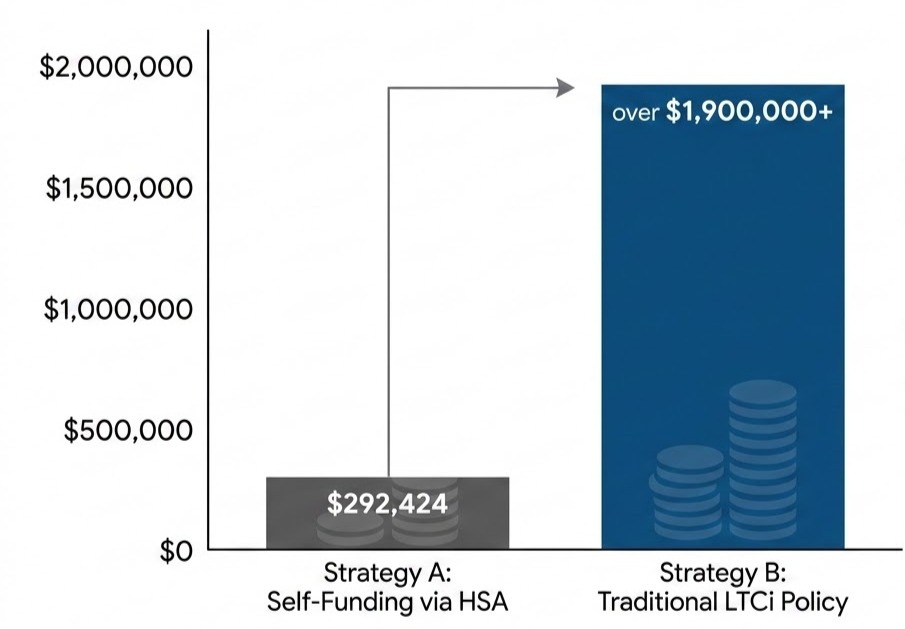
Massive Coverage Leverage: Allocating the same $4,000 annual outlay into a private, tax-qualified LTC policy (with shared care and compound inflation riders) creates immediate day-one coverage that can grow to over $1.9 million in tax-free benefit pool access.
-
Schedule A Tax Nuance: Long-term care expenses qualify as deductible medical expenses under IRC Section 213(d). Using pristine HSA dollars burns assets that could otherwise be used for non-deductible healthcare, while traditional IRA withdrawals can already be effectively neutralized when writing large checks to care providers.
-
The Synergistic Strategy: Use your HSA for high-deductible health plan (HDHP) out-of-pocket costs, routine healthcare, and paying qualified LTC insurance premiums up to annual IRS age limits. Let private LTC insurance absorb catastrophic, multi-year asset risks.
A recent financial post made the rounds with seemingly neat spreadsheet logic:
“If I invest $4,000 per year for 25 years at an 8% annual return, my Health Savings Account will grow to $292,424. That’s more than enough to cover the average long-term care stay—and far cheaper than paying insurance premiums.”
On paper, compound interest looks seductive. In the real world of healthcare economics, this calculation collapses under scrutiny.
Future Cost Realities: While $292,000 sounds substantial today, long-term care inflation consistently outpaces general CPI due to intense healthcare labor constraints. In 25 years, around-the-clock home health or private memory care will run $250,000 to $350,000+ per year. A $292,000 HSA balance will barely fund 10 to 14 months of skilled care.
Insurance Cost Misconceptions: A healthy 40- or 50-year-old couple does not necessarily need to spend $4,000 annually to secure meaningful protection. However, if a couple did commit $4,000 annually to a traditional, partnership-qualified policy featuring shared care and a 3% compound inflation rider, their leveraged benefit pool could exceed $1.9 million tax-free by age 75 or 80.
3 Fatal Flaws of Using an HSA to Self-Insure
Let’s dismantle the three major flaws of using an HSA to self-fund care:
1. The Tax Deductibility
Advocates celebrate the HSA’s triple-tax advantage: pre-tax contributions, tax-free growth, and tax-free withdrawals for qualified expenses. However, qualified long-term care expenses already meet the threshold for deductible medical expenses under IRC Section 213(d) on IRS Form 1040 (Schedule A). If a catastrophic care event strikes and you are forced to self-fund, it is far more tax-efficient to liquidate ordinary retirement accounts (like a Traditional IRA or 401(k)):
-
You pull taxable income from the IRA.
-
You pay the care facility directly.
-
The large medical expense deduction on Schedule A largely or completely offsets the taxable income generated by the IRA distribution.
Triple tax-free HSA assets on an expense that already neutralizes taxable ordinary income destroys your portfolio’s tax diversification.
2. The Timing Trap and Immediate Protection
Every self-funding plan assumes nothing bad happens during the accumulation phase. You tell yourself, “I’ll invest for 25 years until age 65 or 70.”
What happens if an unexpected illness strikes at age 52 or 58?
Consider an unexpected event: a stroke, Parkinson's diagnosis, cognitive decline, or a major auto accident at age 54 (Year 10 of your plan).
-
At Year 10, your HSA contains roughly $60,000.
-
At $8,000 to $12,000 per month for private care, that entire 10-year savings balance evaporates in 5 to 8 months.
Once that account hits zero, you are forced into an unplanned liquidation of non-qualified investment accounts or primary retirement assets during potential market downturns. This triggers capital gains, disrupting your sequence of returns, and compromising your surviving spouse’s standard of living.
Private long-term care insurance provides its entire benefit pool starting on Day 1.
3. The Reality of High-Deductible Healthcare
To contribute to an HSA, you must be enrolled in an eligible High-Deductible Health Plan (HDHP). Maintaining an untouched $292,000 balance requires a quarter-century of near-perfect health across your household. In real life:
-
Unexpected appendectomies or outpatient procedures
-
High-cost diagnostic scans (MRIs/CTs)
-
Orthopedic surgeries, physical therapy, and prescription drugs
-
Family deductibles running several thousand dollars annually
These everyday medical costs steadily draw down HSA balances. The assumption that an HSA will sit untouched and pristine for a quarter century while life happens around you is pure fantasy.
A Complete, Resilient Healthcare Plan
Maxing out your HSA is fantastic advice. I’ve done it for decades. But an HSA is built to handle out-of-pocket costs, copays, deductibles, dental, and vision. Long-term care insurance is portfolio insurance designed to protect your life savings from catastrophic six- or seven-figure care events.
When you combine a robust HSA with an affordable policy, and even use pre-tax HSA distributions within IRS age limits to pay qualified long-term care premiums, you create an airtight financial strategy.
Don’t let flawed social media math gamble away your family’s future security. If you want to review real numbers tailored to your age, health, and state, visit our Policy Finder. It is completely anonymous, takes about two minutes, and requires no phone number. Within one business day, we’ll email you accurate comparisons from top-rated carriers across the country.