
Executive Summary
- The Welfare Trap: Transferring your home into an irrevocable Medicaid Asset Protection Trust to bypass the 60-month lookback can force you onto a public welfare program instead of creating a viable retirement care plan.
- Severe Loss of Autonomy: Irrevocable trusts strip you of property control, eliminate equity borrowing options, and place your primary asset at the mercy of a trustee.
- Where Care Actually Happens: Congressional Budget Office data shows only about 1 in 8 individuals receiving care are in nursing homes; 80% to 90% receive care at home or in assisted living, settings where Medicaid is rarely accepted.
- The Superior Asset Protection: State-approved Long-Term Care Partnership policies provide dollar-for-dollar asset protection without requiring you to surrender deed ownership or rely on public welfare.
Every week, I review dozens of articles on retirement planning, asset protection, and long-term care. Most of what passes for financial advice online is incomplete, out of date, or dangerously backward.
A prime example recently came from 24/7 Wall Street, titled: “Five-Year Head Start: Families That Move the House into the Right Trust Early Keep It From the Nursing Home Entirely.” The author argued that if you transfer your house into an irrevocable trust at least five years before needing care, you beat Medicaid’s 60-month lookback period, keep the nursing home from claiming your home, and let the government foot the bill.
My longtime colleague and industry authority, Bill Comfort, published a sharp rebuttal on LinkedIn:
“Impoverishing yourself to qualify for a welfare program is not a long-term care plan. It’s a surrender of choice, control, and dignity.”
Bill is right. What content creators portray as a clever loophole is actually a deliberate path to poverty. Medicaid is not an entitlement benefit like Medicare; it is a means-tested safety net designed for the indigent. When you deliberately restructure your life’s assets to qualify for welfare, you invite severe unintended consequences.
Case Study: The Cold Reality of Relying on Medicaid
In my book, Simple LTC Solution, I detailed a situation that hit close to home.
A close relative of ours began experiencing severe health declines while living 1,300 miles away. Managing her care remotely was unsustainable. We arranged for her to relocate closer to us, scheduled movers, put her home on the rental market, and started touring local facilities.
We immediately hit a wall.
The closest facility informed us there was an active six- to twelve-month waiting list for open beds. In her fragile medical state, waiting nine months was impossible. We needed safe, immediate care.
Then, as an aside, we informed the admissions director that she owned a private long-term care insurance policy with a $10,000 monthly benefit.
The director looked up from the paperwork and said: “The waiting list does not apply to her.”
She was admitted immediately.
Why? Because Medicaid reimbursement rates are often far below the actual cost of private, quality custodial care. As a result, premier facilities strictly limit or ban Medicaid admissions.
When you depend solely on Medicaid, you are at the mercy of bureaucratic quotas, shared rooms, and limited bed availability. We eventually moved her from that facility into a premier assisted living community, one that did not accept Medicaid at all. When COVID-19 hit months later, the facility that accepted Medicaid had an infection rate above 50%, while her private assisted living community recorded an infection rate of 0%.
Planning for the Wrong Setting: The 1-in-8 Reality
The biggest flaw in the irrevocable trust strategy is that it plans for the wrong care setting. Irrevocable Medicaid trusts focus obsessively on protecting the house from a “nursing home.”
Yet according to data from the Congressional Budget Office (CBO), only about 1 in 8 people receiving long-term care are in a nursing home.
Between 80% and 90% of all care takes place at home or in private assisted living communities.
The Olson Rule of Long-Term Care:
Long-term care is not end-of-life care; it’s living a long life with care.
Medicaid primarily covers custodial care inside certified nursing homes. Most private-duty home care agencies and top-tier assisted living facilities do not accept Medicaid.
If your core strategy is surrendering your deed to pass a 5-year Medicaid audit, you are positioning yourself to enter the exact institution you want to avoid. This also eliminates the liquid capital needed to pay for private in-home caregivers.
3 Hidden Risks of an Irrevocable Medicaid Asset Protection Trust
Deeding your real estate into an irrevocable trust creates immediate structural vulnerabilities:
1. Total Loss of Autonomy: You no longer own your home. You cannot sell the property to downsize, relocate, or move closer to family without the explicit consent and execution of the trustee.
2. Zero Access to Home Equity: Because you do not hold legal title, you cannot secure a Home Equity Line of Credit (HELOC) or a reverse mortgage to fund home modifications or private care aides.
3. Third-Party Liability Exposure: Transferring ownership to an adult child or third-party trustee exposes your asset to their personal life events, including divorce settlements, personal bankruptcy, and civil judgments.
How Partnership Policies Protect Assets
How do you protect your home equity and portfolio without locking your deed in an irrevocable trust or signing up for welfare? You use a Long-Term Care Partnership policy. Over 40 states operate government-approved Long-Term Care Partnership programs. These policies provide contractually guaranteed, dollar-for-dollar asset protection.
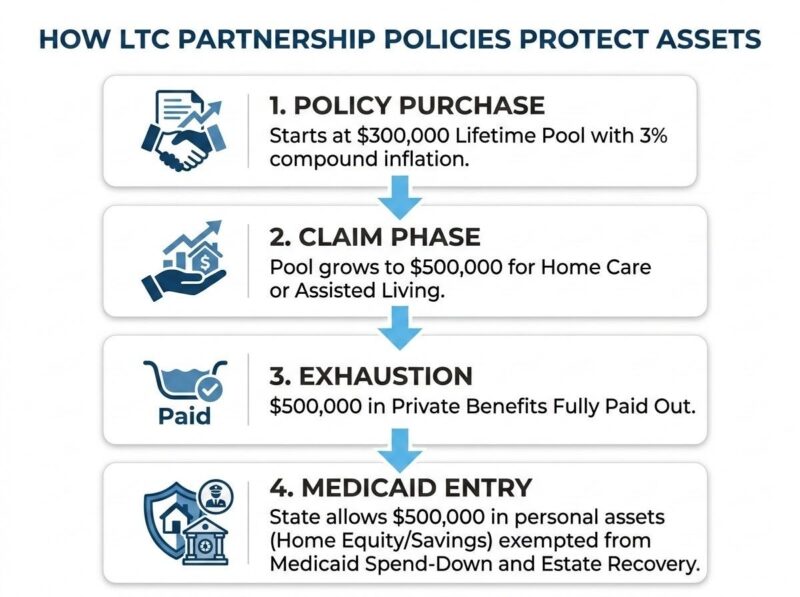
Suppose you purchase a partnership-qualified policy with an initial pool of $300,000. You add a 3% compound inflation protection rider, meaning the pool grows each year automatically without premium spikes. By the time you need care at age 80, that benefit pool has grown to $500,000.
You use the policy to fund licensed home health aides or the private assisted living facility of your choice. If you exhaust every penny of that $500,000, you can then transition to Medicaid.
Under partnership rules, the state allows you to retain $500,000 of your personal assets, including your home equity and cash accounts, above the standard statutory Medicaid limits. Those assets are fully exempt from Medicaid spend-down requirements during life and protected against Medicaid Estate Recovery after you pass away.
You keep the deed in your name. You maintain total control over your real estate. You avoid bureaucratic facility waiting lists. Most importantly, you give your family the resources to serve as your care managers, not your exhausted caregivers.
To see what customized long-term care coverage looks like for your age and health history, go to LTCShop.com and click on Policy Finder. Answer a few basic questions, and within one business day, we’ll email you a clear quote comparing top-tier policies. You can remain completely anonymous, and no phone number is required.
Compare Your Real Options at LTCShop.com
Ready to see how a customized, partnership-qualified policy works for your specific age, state, and health history?
Use our proprietary Policy Finder:
-
Compare Top-Rated Carriers: Side-by-side pricing from the industry’s leading insurers.
-
100% Anonymous: No phone calls, no aggressive sales pitches, and no obligation.
-
Expert Insight: Receive a clear comparison in your inbox within one business day from Scott A. Olson, CLTC®.
